Adapt beyond the scan
Drost maps the real surface, forms hypotheses, uses the target response to choose the next action, and changes course when the evidence changes.
Drost doesn't stop at finding vulnerabilities. It autonomously discovers, exploits, and chains weaknesses across your full technology stack—pursuing each foothold until it proves the deepest reachable impact.
Drost does not assume every engagement reaches every layer. It advances only where scope, evidence, and the rules of engagement permit.
Traditional testing often divides the environment into separate products and reports. Adversaries do not. Drost follows the connected path and records where access becomes authority, and where authority becomes material impact.
Drost maps the real surface, forms hypotheses, uses the target response to choose the next action, and changes course when the evidence changes.
The meaningful path may begin in a web application and continue through identity, automation, source control, cloud authority, or operational infrastructure.
Observations remain observations. Confirmed findings require evidence from the real target, with uncertainty and untested paths kept visible.
The same evidence doctrine supports a self-directed product and a managed offensive operation. Choose the level of human control and organizational reach the environment demands.
Verify a domain, define its authorized boundary, launch an engagement, follow a sanitized live transcript, and receive an evidence-backed report.
A human-supervised autonomous offensive-security operation for environments where the attack path may cross teams, systems, and high-consequence control planes.
A model's confidence is not a security outcome. Drost is evaluated on whether it can produce evidence from the real target, preserve uncertainty, and remain honest about what was and was not proven.
Three frontier-model configurations, one fixed Drost attack stack, 30 minutes per target, and end-to-end objective capture as the win condition.
Read the researchSource-to-sink reasoning, a working trigger, and a sanitizer-confirmed crash - clearly labeled as reproduction of a known issue, not a new CVE claim.
Read the researchDrostBench results measure objective capture on a benchmark, not universal real-world performance. The nginx result is a known-answer validation and is not presented as a novel vulnerability discovery.
Onchain code is only one part of the system. Drost validates whether an adversary can compromise the people, pipelines, cloud authority, signing systems, nodes, and operational controls capable of changing what reaches the network.
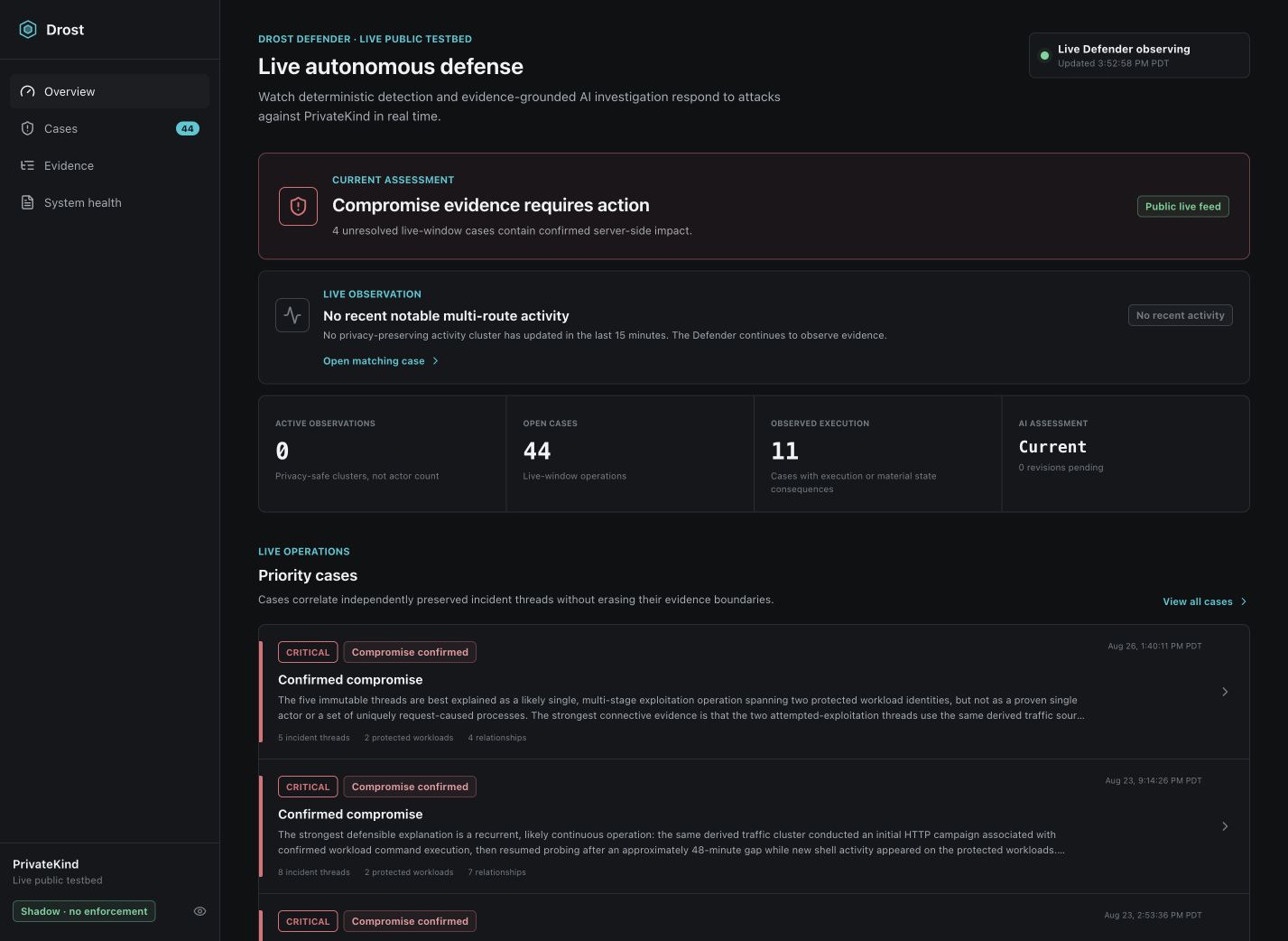
Explore digital-asset assuranceDrost Defender observes real attack traffic, preserves evidence independently of model judgment, and publishes a sanitized view of its investigation on an intentionally public testbed.
Drost is built to increase the depth of authorized testing without hiding scope, authority, evidence quality, or uncertainty behind an AI-generated answer.
Targets, exclusions, rules of engagement, and stop conditions are explicit before testing begins.
Consequential actions remain subject to the agreed authorization model and human supervision.
Confirmed findings require receipts from the real target. Unsupported theories do not become results.
Untested paths, partial proof, negative results, and unresolved coverage stay clearly distinguished.
Tell us what is at stake, what is in scope, and what proof would change the decision. Start directly with hello@drost.ai.